
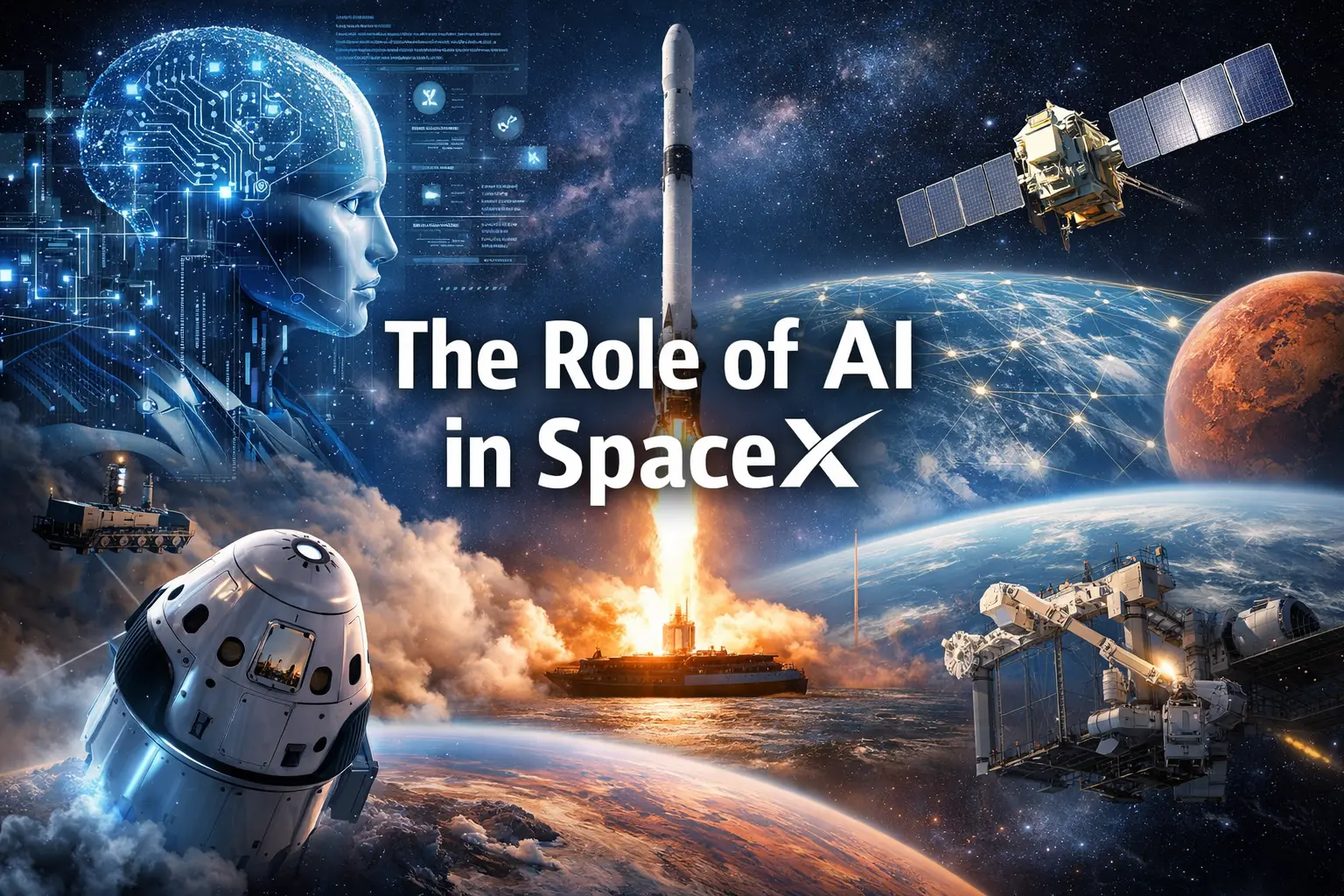
The Role of AI in SpaceX
Artificial Intelligence (AI) has been the key factor in the major technological changes that have been made possible in the last few years. Essentially, it has restructured many sectors, among which healthcare and finance are the most prominent.
However, the aerospace industry still remains included in this transformation. Founded by Elon Musk in 2002, SpaceX pioneers the use of AI to explore beyond our planet. Without the help of AI, SpaceX wouldn’t be able to accomplish its goal, which is “to make life multiplanetary. SpaceX employs various AI techniques such as machine learning, smart automation, and neural network-based algorithms.
SpaceX uses AI in almost every process, whether it is rocket design, data handling, autonomous spacecraft navigation, or satellite constellation optimization. AI has been what has made it possible for the company’s big dream. The article explains the role of AI as the main source of radical changes at SpaceX, a company that is rapidly moving the whole field of aerospace and space exploration to the next level.

AI in Rocket Design and Manufacturing
SpaceX’s success comes from deeply integrating AI throughout its pipeline, using AI tools to innovate faster than conventional rivals.
Generative Design and Simulation
By means of AI-powered generative design, SpaceX engineers can specify performance criteria such as weight, strength, and thermal resistance, and have an algorithm generate thousands of different design possibilities. These AI tools employ deep learning and genetic algorithms to gradually evolve and optimize designs that comply with the given criteria in a fraction of the time and with much more of the work being done by the machine than by human engineers.
As a matter of fact, AI produces blueprints for parts of the hardware, such as fuel tanks, nozzles, and turbopumps, thereby allowing the engineers to accurately point out the areas in the structure that are weak long before the stage of physical prototyping. SpaceX uses reinforcement learning in its simulation systems; therefore, it gets feedback from past outcomes, so it keeps on perfecting not only the choice of materials but also the structural designs, which, in the end, result in both time and money savings in production.
Predictive Maintenance in Manufacturing
Also, AI is the primary factor that leads to predictive maintenance at the SpaceX production facilities. The sensors are always on, watching the vibrations, temperatures, and other performance parameters of the robotic arms and CNC machines. Machine learning algorithms sift through this data to not only recognize the weakest points but also to forecast breakdowns, thus enabling the maintenance crew to be on time and production to go on without interruptions. Besides being a highly accurate instrument in the rocket-making process, AI is also very helpful in guaranteeing safety and trustworthiness through the fabrication of each unit as per the tightest standards.
AI in Rocket Operations and Launch Systems
SpaceX’s launch systems rank among the most technologically advanced on the planet, and AI controls almost every aspect of their operation—from pre-launch checks to flight path optimization and recovery.
Autonomous Flight Control
Autonomous flight control systems are one of the most impressive AI applications at SpaceX. Basically, these are the systems that enable rockets to make on-the-spot decisions during both launch and re-entry. Falcon rockets use ML models to forecast environmental variables like wind shear and adjust their thrust vectoring and control surfaces accordingly. By using deep reinforcement learning, these algorithms have acquired the ability to deliver rockets back to Earth for vertical landings with amazing accuracy. AI-based guidance and control now routinely achieves what was once impossible: landing a 70-meter rocket vertically on a floating drone ship.
Launch Pad Automation
On top of that, AI is in charge of automated launch pad operations as well. Robotic systems perform operations such as fueling, temperature regulation, and system diagnostics. Thus, the risk for humans is lowered, and the efficiency is increased. The software is very thorough in its monitoring as it keeps an eye on thousands of sensors constantly, looking for any anomalies—such as leaks or pressure changes—that can be as small as incidents or even the beginning of a problem.
The use of AI in the integration of ground systems is a great tool for SpaceX to keep up with their fast launch cadence, which is the reason why they can sometimes carry out several launches in a single week.
AI in Autonomous Landing and Recovery
One of the most pioneering things that SpaceX has done is how they can bring down and use again their rockets, which is a major factor in reducing the total cost of a launch by millions of dollars and hence making trips to space much more eco-friendly. The whole operation is very dependent on AI-driven navigation tools, machine vision, and sensor fusion.
Real-Time Navigation and Control
After the journey, Falcon 9’s onboard AI figures out its orientation and position by using GPS, radar, and inertial data. The program determines the minimal engine throttling and the grid fin adjustment that will bring the booster back to its landing site.
Such a quick, uninterrupted operation, the AI evolves from every single flight to be able to perform better in the next one. SpaceX has made over 300 consecutive booster landings without failure, a feat that could only be accomplished by AI handling the complicated atmospheric re-entry variables.
Neural Networks for Image Recognition
For visual recognition and tracking at the time of landings, SpaceX has adopted neural networks. The entire descent of the rocket is recorded through very high-resolution cameras, and thereafter, AI algorithms go through these images to find the landing pad and to also adjust if the rocket is a little off. This technology allows the rocket to be very accurate, even to the extent that if GPS signals are interrupted, or the weather is not favorable (e.g., strong winds or low visibility), it can still land precisely.
AI in the Starlink Satellite Network
Arguably one of the most daring AI-enabled initiatives backed by SpaceX is Starlink, the worldwide satellite network designed to offer broadband anywhere on Earth. As there are now more than 6,000 satellites up in the air (with the intention of putting up 50,000 in total), no human could possibly manage such a system without AI.
Autonomous Satellite Operations
Engineers design Starlink satellites as semi-independent systems. They rely on their onboard AI units for tasks such as collision avoidance, changing of the orbit change, and power management. The AI onboard these satellites interprets the data coming from their sensors and also from the systems that track space debris, so that they can make adjustments at once, thus reducing the chances of a collision in low Earth orbit (LEO).
The U.S. Space Force has acknowledged the effectiveness of the autonomous collision avoidance system of Starlink that relies on predictive AI models, which in turn analyze orbital data from several sources.
Network Optimization
In addition, artificial intelligence is in charge of the effectiveness of the network of Starlink. Machine learning algorithms are always changing bandwidth, latency, and signal strength for millions of users in real-time.
By using AI, Starlink is able to enhance the performance of its terrestrial network. It looks at the usage data that is being collected in real-time and, based on that, it routes traffic, that is, changes the traffic flow, relieves latency, that is, delays in the transmission of data, and improves the overall performance of the user experience.
AI in Spacecraft Autonomy: Dragon and Starship
AI meets SpaceX’s spacecraft challenges by heavily utilizing autonomous flight, docking, and re-entry operations for Dragon and Starship.
Autonomous Docking Systems
An AI-powered autonomous system enables the Crew Dragon vehicle to dock with the ISS on its own. In order to achieve the goal of a fully automated docking without any kind of human support, the different systems under discussion utilize computer ray tracing, LIDAR, and neural networks.
According to NASA astronauts, AI onboard systems dock the Crew Dragon more quietly and efficiently than manual operations. Nonetheless, the possibility of a manual override is still there in case of safety.
Starship’s AI-Driven Systems
The Starship, a vehicle intended for the colonization of Mars, is taking AI autonomy to a new level. It has incorporated AI in many areas such as flight control, life-support monitoring, trajectory optimization, and planetary landing.
In case of communication delays that can last as long as 20 minutes, AI will have to be the co-pilot of the spaceship, and it should be able, on its own, to handle navigation, obstacles, and energy consumption.
This man’s freedom is a must for trips to Mars, a place where only self-dependent AI systems will be able to keep living conditions.
AI for Space Data Analysis and Research
Space ventures generate vast data; SpaceX uses AI to process and interpret this information with speed and accuracy.
Telemetry Analysis
Each rocket launch is a source of telemetry data measured in terabytes, which includes temperatures, engine performance, and pressure readings. Machine learning algorithms are used on this data to find anomalies, failure prediction, and design improvement suggestions.
The continuous feedback loop of this data enables SpaceX to enhance its hardware and software systems at a pace that is incomparable with traditional aerospace companies.
.Space Debris Monitoring
Furthermore, AI helps in the detection of space debris that limits the use of the orbital area. SpaceX uses AI algorithms that process radar and telescope data to find potential clip points between satellites and debris. In other words, the satellites are able to manage themselves
Starlink satellites independently decide and execute maneuvers to avoid collisions, thereby minimizing the risk of crashes without any direct human intervention.
AI and Human Collaboration
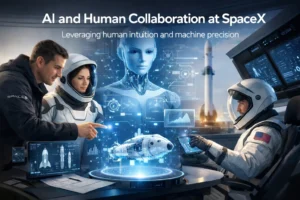
Even though the company has a very high automated system, SpaceX still advocates for human-AI collaboration. Engineers and data scientists set up AI algorithms that learn from the environment, and then these algorithms give the insights that help human decisions, thus completing a loop of feedback.
AI-driven simulation outputs are used by SpaceX engineers to identify the best designs; at the same time, the AI co-pilots are making the spacecraft safer for the astronauts. The mutual engagement of human intuition and machine precision is the hallmark of the revolutionary culture of SpaceX.
Ethical and Safety Considerations
With SpaceX increasingly using AI systems, the question of ethics and the safety of those systems has become of great importance to the company. The issue of safety is the most important one that should be solved first; the self-governing installations ought to be able to function in a logical manner in any scenario without causing a risk to devices or human beings.
Transparency and Explainability
SpaceX promotes openness as a key feature of AI-based decisions. The engineering team develops the AI to be able to give reasons for its actions, which is an instance of explainable AI (XAI).
In this way, the system remains accountable, and the mission leaders can trace the AI’s logic and understand the reasons behind its decisions, even when it operates under combined pressures.
Cybersecurity in AI Systems
The Future of AI at SpaceX
Future Starship flights to Mars will use self-learning AI models to autonomously handle diverse conditions without human intervention. During dust storms or communication delays, self-learning AI agents autonomously adapt to the new environment and continue operating.
AI will be central to terraforming Mars and managing the colony, handling habitat maintenance, energy systems, and autonomous robotic construction. To a large extent, AI powers the company’s dream of creating a spacefaring civilization.
Conclusion
SpaceX’s story goes beyond engineering talent, showing how artificial intelligence has been a major factor in its success. SpaceX uses AI across its operations, from vehicle design to autonomous navigation, pushing the limits of aerospace engineering. Reusable rockets, autonomous spacecraft, and global internet are today’s reality, achieved through the work of intelligent algorithms at SpaceX.