
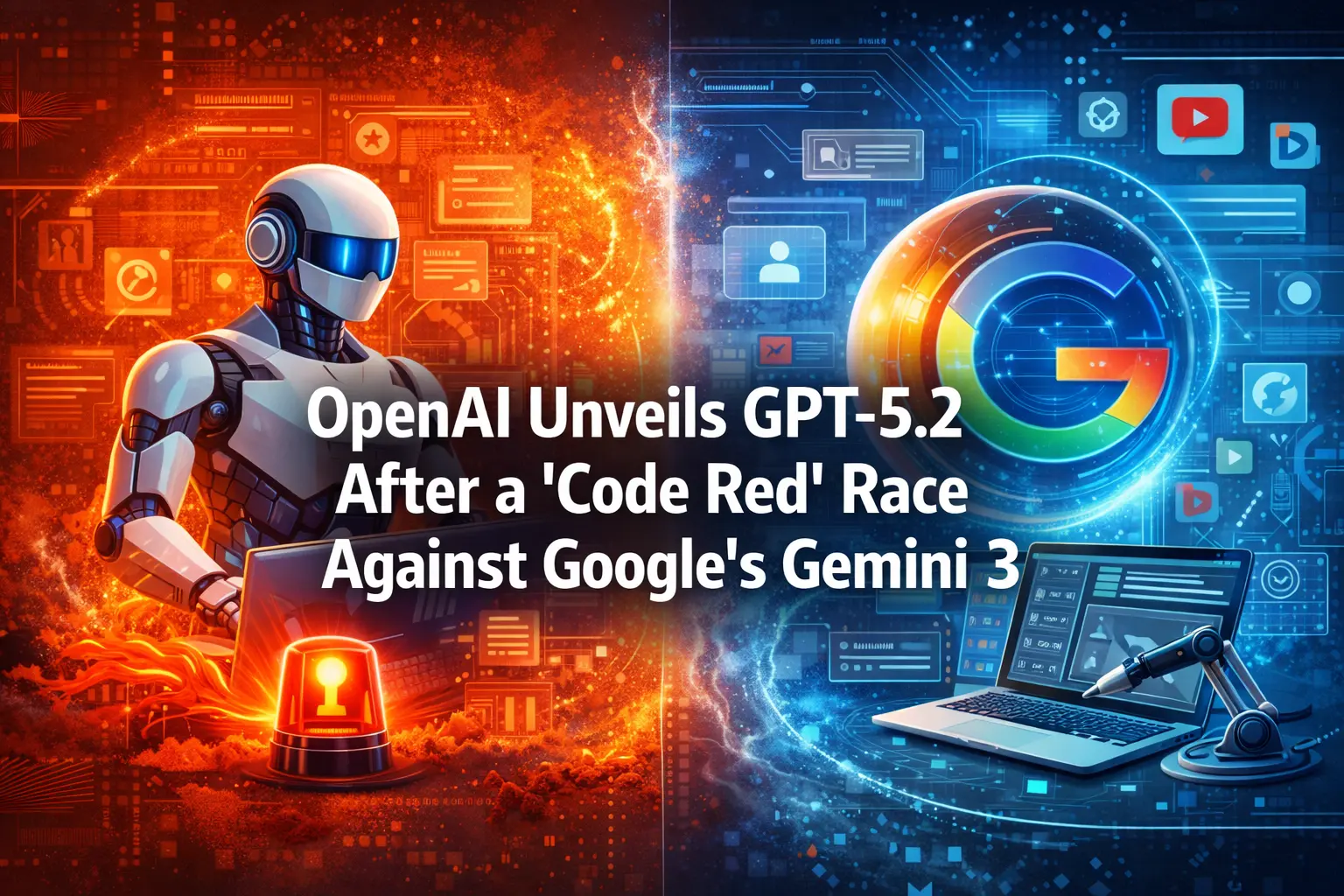
OpenAI Unveils GPT-5.2 After a ‘Code Red’ Race Against Google’s Gemini 3
In the AI world, a turning point is seldom quiet—and this time was no different. OpenAI has officially announced GPT-5.2, a significant update released at a time when the global AI race is at its hottest. What makes this launch particularly dramatic is the story behind it: GPT-5.2 was forged under an internal “code red” directive, a direct response to the rapid rise of Google’s Gemini 3. For months, the industry had buzzed with speculation over which giant would make the next big leap.

Google’s Gemini 3, with its powerful multimodal features and deep reasoning, was widely seen as a direct challenge to OpenAI’s long-standing leadership. The stakes for OpenAI were clear: the company needed a decisive answer. GPT-5.2 is that response—not merely an upgrade, but a statement of intent. It is a message that OpenAI is not stepping back. With faster reasoning, smoother multimodal abilities, stronger alignment, and a more intuitive user experience, GPT-5.2 stands as one of the most polished and capable AI models ever built.
A “Code Red” Moment: Why OpenAI Rushed GPT-5.2
The term “code red” is usually reserved for situations where a company’s market position or product relevance is under serious threat. According to insiders, that’s exactly how OpenAI viewed the arrival of Gemini 3. Google’s model didn’t just offer incremental improvements—it showcased strengths that directly overlapped with OpenAI’s goals:
More advanced multimodal reasoning
Smoother image-video-text integration
Enterprise-ready tools and safety layers
Deep reinforcement learning for long tasks
For OpenAI, this wasn’t just competition; it was a potential shift in industry leadership. Gemini 3 quickly became a favorite among researchers and tech firms who were looking for powerful multimodal AI. And with Google’s massive ecosystem—Search, YouTube, Android—Gemini had the advantage of being deeply integrated into tools billions of people already use. So OpenAI accelerated development. Teams were on fire to fine-tune the GPT-5 design, enhance its performance, and bring in new features that would not only be able to challenge Gemini 3 but also be superior to it in the main aspects.GPT-5.2 is the result of that push.
What Makes GPT-5.2 Different
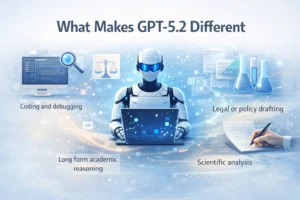 While it is still based on GPT-5, the new 5.2 version is a major upgrade that has its positive effects very much visible to the users in their daily interaction. People say that the dialogues flow more naturally, the answers are more correct, the logical capacity is stronger, and the overall comprehension is much more human-like. Let’s break down the biggest changes.
Much Better Real-Time Thinking
It is quite clear that GPT-5.2 has been significantly upgraded in the area of reasoning. The model is able to break down a multi-step question much more clearly than before, and it also provides more open explanations of the way it came to the solution.
Where this improvement matters most:
Coding and debugging
Long-form academic reasoning
Legal or policy drafting
Scientific analysis
Research-heavy writing
This is the model that feels more “thoughtful” and less mechanical, making it a strong competitor to Gemini 3’s advanced reasoning engine.
A Huge Multimodal Upgrade
Multimodality—the ability to understand and generate text, images, video, and audio—is at the heart of modern AI.
GPT-5.2 improves OpenAI’s multimodal abilities in several ways:
It interprets images with greater accuracy and detail
Videos are analyzed with greater accuracy.
It provides cleaner audio transcription and reasoning
It can blend different types of inputs smoothly
If earlier versions of GPT felt slightly disconnected when switching between modalities, GPT-5.2 feels much more natural and fluid.
Faster, Smoother Performance
Another thing users immediately notice is the improved speed. GPT-5.2 responds faster, even during very complex tasks.
This comes from:
lighter token processing
optimized inference architecture
better hardware scaling
For developers and enterprises, the performance boost means faster deployment and less server load. For everyday users, it simply means a more satisfying experience.
Better Safety and Fewer Hallucinations
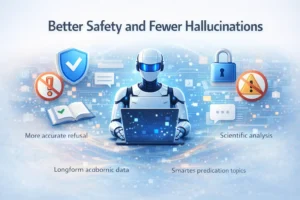
AI safety has become one of the biggest concerns in the industry. OpenAI has tightened alignment in GPT-5.2 with:
more accurate refusal behavior
improved factual grounding
clearer contextual awareness
better handling of sensitive or risky topics
Hallucinations—incorrect or invented information—have been reduced significantly. It’s far from perfect, but GPT-5.2 feels much more reliable.
Smarter Memory and Personalization
Memory is one of the most important features in modern AI assistants. GPT-5.2 comes with an upgraded memory system that:
remembers user preferences
continues tasks across multiple days
adapts to writing style or tone
improves long-term personalization
This makes the model feel more like a real assistant instead of a session-based chatbot.
Improved Agent Capabilities
AI is gradually evolving from simple text generators into active digital agents capable of completing tasks. GPT-5.2 takes a step forward by improving:
tool usage
task planning
multi-step execution
API interaction
workflow automation
This positions OpenAI strongly in the emerging “AI agents” market, where models act as autonomous digital workers.
GPT-5.2 vs. Google Gemini 3: The Real Comparison
The question everyone has been asking is whether GPT-5.2 is better than Gemini 3. The answer isn’t simple—both models excel in different ways.
Here’s where GPT-5.2 shines:
More natural and human-like writing
Better long-form creativity
Stronger coding and debugging support
More reliable alignment and safety
Better enterprise customization
Here’s where Gemini 3 leads:
Deeper multimodal integration
Faster video + image comprehension
Stronger integration with Google apps
Better mobile (Android) optimization
And in some areas, they’re nearly tied:
General reasoning
Knowledge accuracy
Multilingual performance
Audio understanding
GPT-5.2 rebalances the competition, ensuring that OpenAI is still firmly among the top two players globally.
What GPT-5.2 Means for Everyday Users
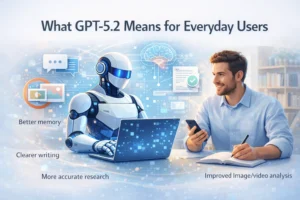
Regular people using ChatGPT will notice:
smoother conversations
better memory
fewer mistakes
clearer writing
More accurate research helps.
improved image/video analysis. It really turns ChatGPT into a personal assistant that understands what you need and adjusts to your way.
What GPT-5.2 Means for Businesses
For companies, the upgrade offers major benefits:
stronger automation tools
deeper integration into internal systems
better model reliability
improved API performance
more stable enterprise workflows
Many businesses had started experimenting with Google’s Gemini precisely because of its strong multimodality. GPT-5.2 gives them a strong reason to stay with or return to OpenAI.
Why GPT-5.2 Matters for the Future of AI
Every major AI release pushes the entire industry forward. GPT-5.2 is important for several big reasons:
It accelerates the AI arms race
OpenAI and Google are pushing each other faster, which ultimately benefits the entire world.
It sets a new standard for multimodal understanding
AI is now moving beyond text into rich, layered digital comprehension.
It pushes AI closer to real autonomy
Agents powered by GPT-5.2 could handle complex tasks with minimal human input.
It improves AI safety
A safer model means more trust from governments, businesses, and general users.
It shows that the future of AI will be assistant-based
AI is becoming a daily tool—not a toy or novelty.
Conclusion:
GPT-5.2’s debut is anything but just another routine update. It’s a major landmark. With Google’s Gemini 3 raising the competition, OpenAI needed something bold, something powerful, something that could re-establish its leadership.GPT-5.2 delivers exactly that. It’s faster, more capable, more intuitive, and more aligned than its predecessors. It brings OpenAI back into a strong competitive position and sets the stage for an exciting new era of AI development. As users begin experiencing GPT-5.2 across ChatGPT and API integrations, it’s clear that we’ve entered a new chapter—one where AI assistants are smarter, more human-like, and more deeply integrated into our digital lives.OpenAI’s “code red” may have been triggered by competition, but the result is a model that will shape the future for years to come.