
AI Trading: Advancements & Future Strategies
Financial market trading has evolved dramatically over time. In the past, traders used to be largely dependent on their own personal experience, gut feeling, and rudimentary understanding of the market. They pored over charts and reports on companies and the economy for hours on end. Subsequently, trading was sped up and facilitated by computers and later by Internet-based platforms. And now, Artificial Intelligence (AI) is driving the biggest transformation yet. AI aids traders in making smarter AI trading decisions, reducing risk, and swiftly reacting to changes in the market. AI development in trading is not just about increasing returns. It is transforming the way markets function, the way risk is managed, and the way traders use information.

Trading Before Artificial Intelligence.
 Before AI was ubiquitous, trade decisions were predominantly human-driven. Traders relied on technical analysis and fundamental analysis to make predictions about price movements. Simple computerized systems were introduced later, but these obeyed fixed rules. They couldn’t learn from past mistakes or adapt to new market conditions. When unexpected events occur, such as financial crises or breaking news, traditional systems are often caught flat-footed. This demonstrated a requirement for more intelligent and adaptable trading instruments.”
What AI Means in Trading
AI trading is the use of intelligent algorithms that can analyze data and adapt their trading strategy accordingly. These platforms incorporate technological tools such as machine learning, deep learning, and NLP to capture the market dynamics. Due to the strong processing power, an AI can process a vast amount of information within a tiny frame of time, which is not possible for human beings to do manually.
AI algorithms analyze different kinds of data, including movements in prices, volume of trading, company earnings, business reports, and market indicators. AI also interprets written content, including news stories, financial documents, and even tweets. When you put all of this information together, AI can find patterns, trends,s and signals that even the most experienced human trader might miss. That transparency that they can not only access, but also digest, makes them more accurate in their decisions and more nimble in responding to market changes.
Role of Machine Learning in Trading
Machine learning is a very significant element of AI-based trading. It enables computers to learn from historical market data and apply that knowledge to forecast future price changes. Utilizing past prices, trading volume, and market trends, predictive models such as machine learning can potentially predict if prices will rise or fall. They may also flag potentially suspicious or anomalous market behavior that traders should take additional notice of. While these systems continue to trade, they accumulate knowledge from both winning and losing trades. This never-ending culture of analysis and refinement is what helps boost their efficacy with time. AI systems don’t get tired, stressed, or emotional while making decisions, unlike human traders. This control of emotions makes the ML-based trading system consistent and disciplined even in times of market chaos.
High-Frequency Trading and Automation
Speed is of the essence in today’s financial markets, and this is where the AI really shines. What is high-frequency trading (HFT)? High-frequency trading, or HFT, is enabled by AI systems that are capable of processing market data and executing thousands of trades in the span of just a few seconds. These algorithms monitor the prices in pseudo-real time across multiple markets and capitalize on tiny, ephemeral price differences lasting only a few seconds. High-frequency trading makes markets more liquid and efficient by enabling faster buying and selling of assets. But the superfast trading can also add risk, particularly during sudden market shocks or unforeseen events. If a bunch of AI systems react all at once, it could cause sudden price swings. Regulators must institute strict monitoring, control, and regulation to ensure HFTs operate safely and stably, thereby justifying their continued use.
Natural Language Processing and Market Sentiment

Markets are fast-moving, constantly digesting news and sentiment, with AI now accelerating these responses further. Leveraging Natural Language Processing, NLP AI takes a read ofa large amount of text – be it news, financial reports, or tweets. Based on that, they predict how the market will react to news and announcements.
With sentiment analysis, the AI determines whether the market is bullish, bearish, or neutral. For instance, a poor earnings report can send out an AI alert prior to a large decline in a stock. In the same way, positive developments or trends can be detected in advance, allowing traders to get an early warning. Such fast processing of the data and then the interpretation provides a key edge to the traders, who with this edge can react to market changes faster and with more insight, resulting in improved decision making inside rapidly moving financial environments.
AI in Risk Management and Portfolio Control
Traditional risk models are based on static assumptions and rely on past data, which can make them ill-suited for sudden market changes. By comparison, AI provides dynamic adaptability. It can simulate hundreds of what-if scenarios, analyze the potential risks, credit to proactive adjust the trading algorithm. It means that strategic rather than reactive decisions can be taken.
In portfolio management, AI assists in excluding extremely risky instruments and increasing coherence of the portfolio through ‘smart’ asset allocation. It constantly observes the market, recalculates the allocations, and rebalances the portfolios to accommodate both the short-term fluctuations of the market and the long-term goals. This means that investors should be able to adapt to turbulent markets, which makes AI an essential tool for modern trading and portfolio management.
AI for Retail Traders
Previously, sophisticated trading was left to the big institutions. Now, AI tools are available to everyday retail traders, too. Trading Robots (Trading Bots) Today, many online trading platforms have included AI-based Bots, smart indicators, and automated systems.
These instruments enable individual traders to diminish emotionally driven decisions and trade with more logic. Even if AI can not assure gains, it gives a better analysis and discipline.
AI in Cryptocurrency Trading
Markets for cryptocurrencies are very volatile, and they trade 24 hours a day. AI is particularly beneficial in crypto trading as it can respond immediately to price fluctuations. AI algorithms track multiple exchanges and asset pairs, and alert you to opportunities. AI sentiment analysis actively studies online conversations to predict crypto price movements.
Challenges and Ethical Concerns
Although the benefits of employing AI in the areas of trading are plenty, it has its own set of challenges. It’s a big secret. Some AI systems make decisions, but do not explain how they arrived at them. Another danger is that a multitude of AI systems could simultaneously respond to each other in the same manner, causing greater instability in the markets. These problems underscore the need for responsible use of AI.
Regulation and Oversight
Both sides of the aisle in the US Congress and financial markets regulators globally are keeping a keen eye on the risks posed by artificial intelligence. Rules are being crafted to promote fairness, transparency, and stability. Going forward, companies may have to explain AI-driven decisions and have humans oversee the automated systems.
Future of AI in Trading
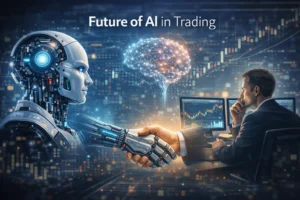
The outlook for AI in trading is notably bright as more and more sophisticated systems come online that are developing complex, evolving strategies. In fact, by analyzing large data sets at blistering speeds, AI can detect complicated market trends and place trades with inhuman accuracy and latency.
Nevertheless, it is improbable that AI will entirely replace human traders. The best solution will be a powerful combination of human and machine intelligence. Traders add the key ingredients that AI is missing: the overarching strategy, a sense of what’s right from an ethical point of view, a subtle appreciation of geopolitical context, and the creative ability to respond to an unprecedented ‘black swan’ event. Humans set objectives, define risk boundaries, and make sure the robot is behaving ethically.
Accordingly, the greatest trading floors of the future will harness the raw power and speed of AI, integrated seamlessly with human wisdom, strategic brilliance, and moral prudence. This partnership approach will characterize the next generation of financial markets that optimize returns while addressing emerging risks.
Conclusion
The development of artificial intelligence-based trading systems is transforming financial markets in powerful and enduring ways. Through sophisticated data processing and algorithms, AI enables traders to make more well-informed decisions. So, it accelerates the trading, making traders respond to price changes and breaking news immediately. From the risk side, AI narrows it twice by detecting problems earlier and by modulating tactics in accordance with the market environment. These advantages are not only for big financial firms, but also for small and retail traders. In the right hands, and with the right amount of human supervision, AI can make trading smarter, more secure, and more efficient for everyone involved. With technology advancing and adapting, AI will continue to be at the forefront of trading and play an increasingly vital role in determining the future of global financial markets in the years to come.