
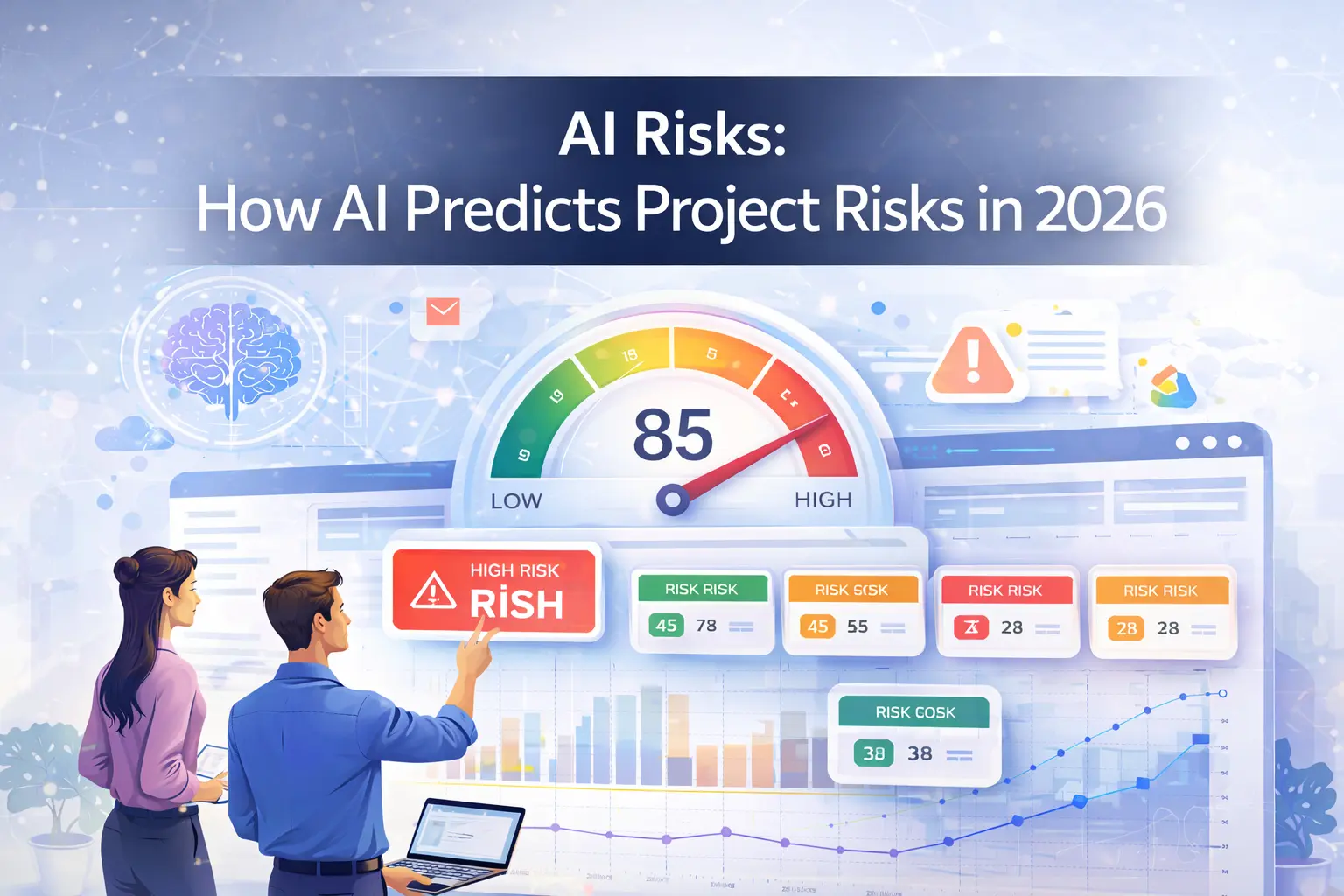
AI Risks: How AI Predicts Project Risks in 2026
Project management has changed a lot by 2026 compared to the past. Projects are more complex, deadlines are tighter, and teams are more global. Because of this, forecasting AI risks has become so important. The success of projects depends heavily on human decisions; even minor errors could cause a major impact, resulting in delays, additional costs, or even failure of the project. This is where Artificial Intelligence, or AI, comes into play.

AI enables project managers to spot issues before they even arise. Instead of responding too late, teams can act early and prevent issues. AI analyzes historical projects, evaluates current project status data, and forecasts future risks with intelligent algorithms. AI operates like an early warning system. It tells the managers what can go wrong and when. This conserves time, money, and stress. For the blog readers, it is interesting to know how AI anticipates project risks because it indicates how high-tech is changing the way companies plan and deliver projects successfully.
What Is Project Risk?
A project risk is something that can affect the project adversely. These risks could affect the project timeline, cost, quality, or the result of the project. For instance, a project could be delayed or running over budget; there could be a shortage of skilled workers, technical problems, or team members may communicate poorly. Even minor problems can become major ones down the line if left unaddressed.
Previously, project risks were captured in meetings, based on experience and guesswork. Managers would gather together and make predictions about what could potentially go wrong. Although this method sometimes worked, it was not always reliable. People get details wrong or underestimate problems. Besides, manual risk management is time-consuming work. Now that’s no longer good enough. By continuously analysing ever larger amounts of data to identify risks that humans might have missed, AI can assist. This is how you make risk management more intelligent and more precise.
Why Traditional Risk Management Is No Longer Enough
Conventional risk assessment is reliant on human judgment. Experience is important, but it is not perfect. People have biases, emotions, and workloads. As a result, decisions may be made too late, or signs of warning may be overlooked. Traditionally, the level of risk is reviewed on a weekly or monthly basis. As a result, risks are often identified only after serious damage has occurred.
Another problem is data overload. Today’s projects produce massive amounts of data—schedules, emails, reports, and financial records. We cannot expect humans to pore through all of this data and do so rapidly. The consequence is that important signals are missed. That’s why even talented teams see most projects fail.
AI solves this problem by working 24/7. It monitors all project information in real time and notifies managers as soon as something seems risky. This makes for speedier, more certain decisions. Conventional techniques simply cannot be that fast and accurate.
How AI Collects Project Data
In 2026, the AI systems will be collecting data about projects automatically from multiple sources. Project managers no longer have to input data by hand. AI integrates with project management software, work trackers, budgeting tools, and communication platforms. It collects information on due dates, progress of work, costs, and workers’ workload.
And AI scans emails, chat messages, and meeting notes. That allows it to get a sense of what’s going on inside the project team. AI quickly detects when tasks are delayed or when team members are overworked. It can even integrate external data, such as market trends or supplier performance.
The greatest benefit is that the AI consolidates all of this data in one location. Humans tend to look at data through a siloed lens, which creates gaps. AI takes into account everything. This holistic perspective is one of the reasons that allows AI to generate better and more accurate risk predictions.
How AI Learns From Past Projects
AI grows smarter by learning from previous projects. It is trained on data from tens of thousands of finished projects. These are both successful and failed projects. AI analyzes patterns to determine what leads to delay, cost overrun, or poor quality.
For example, AI might develop the knowledge that projects with many scope changes tend to run over budget. Or it might predict that teams who have been working long hours and are closely approaching burnoutwill experience a productivity decline. Once AI has learnt these patterns, it applies them to new projects.
When a new project is launched, AI looks for parallels with previous projects. If it detects the same red flags, an early warning is sent to the manager. This enables teams to address problems before they turn severe. This learning capability is one of the most powerful aspects of AI when it comes to predicting project risk.”
Predictive Analytics and Risk Scoring
AI applies predictive analytics to predict future risks. It is not only monitoring the present but also predicting the future. AI then estimates the risk of various events – delays, cost overruns, resource drain, etc.
In 2026, AI tools provide risk scores for different phases of a project, powered by AI. These ratings appear in the form of low, medium, The scores are not static. They are automatically updated when new data comes in. Tasks starting to miss their deadlines, for example, increase the risk score.
This allows project leaders to concentrate on the most important issues. They can point to data-driven alarms rather than just guessing. Predictive analytics enables teams to make better decisions and take proactive measures before risks translate into losses. This leads to more predictable and controlled project results.
AI and Communication Analysis (NLP)
One sophisticated capability of AI in 2026 is Natural Language Processing, or NLP. NLP enables AI to interpret human language. From reading emails to attending meetings, AI is scanning messages for subtle cues of risk. For example, if words like “confused,” “blocked,” or “overloaded” are common buzzwords among collaborating team membersAI considers that a risk. It can be a sign of bad communication, unclear specification, or too much work. People tend to disregard such signs because they appear normal. It relates to emotional tone and project deliverables. If the negative sentiment rises, AI will notify the project managers. It allows managers to address people’s issues sooner. Strong communication is essential to ensuring project success, and AI provides a way to safeguard it.
AI Scenario Testing and What-If Analysis
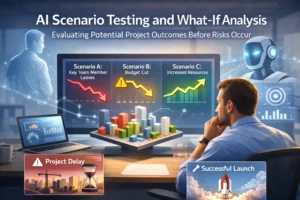
AI can run simulations of various what-if scenarios. In other words, AI runs simulations to predict the potential impact of a change. For instance, it can forecast the effect of losing a key team member or having the budget slashed. Project managers can test multiple scenarios without any real risk. AI finds options and outcomes – fast. AI finds options and outcomes – fast. It means that managers can pick the best option before the problems arise. What-if analysis is particularly beneficial for intricate projects. Instead of speculating, managers have data-driven simulations. This decreases uncertainty and increases trust. In 2026, this capability solidifies AI as a planning companion, rather than just a reporting tool.
Conclusion
AI became a key method for forecasting project risk in 2026. It’s how teams catch problems early, make sense of complex data, and get smarter. Leveraging learning from past projects, real-time activity monitoring, and communication analysis, AI slashes the unknowns in project control. Yet AI does not replace humans. Project managers continue to be critical in leadership, communication, and strategy. The best results are achieved when AI-informed decisions are guided by experienced humans. For business and tech bloggers, writing about such AI advancements in layman’s terms helps readers appreciate how technology is streamlining core business processes. Writing about AI in layman’s terms makes readers appreciate how technology is streamlining ordinary business processes and tasks. AI-based risk prediction isn’t just a fad – it’s the future of effective project management.