
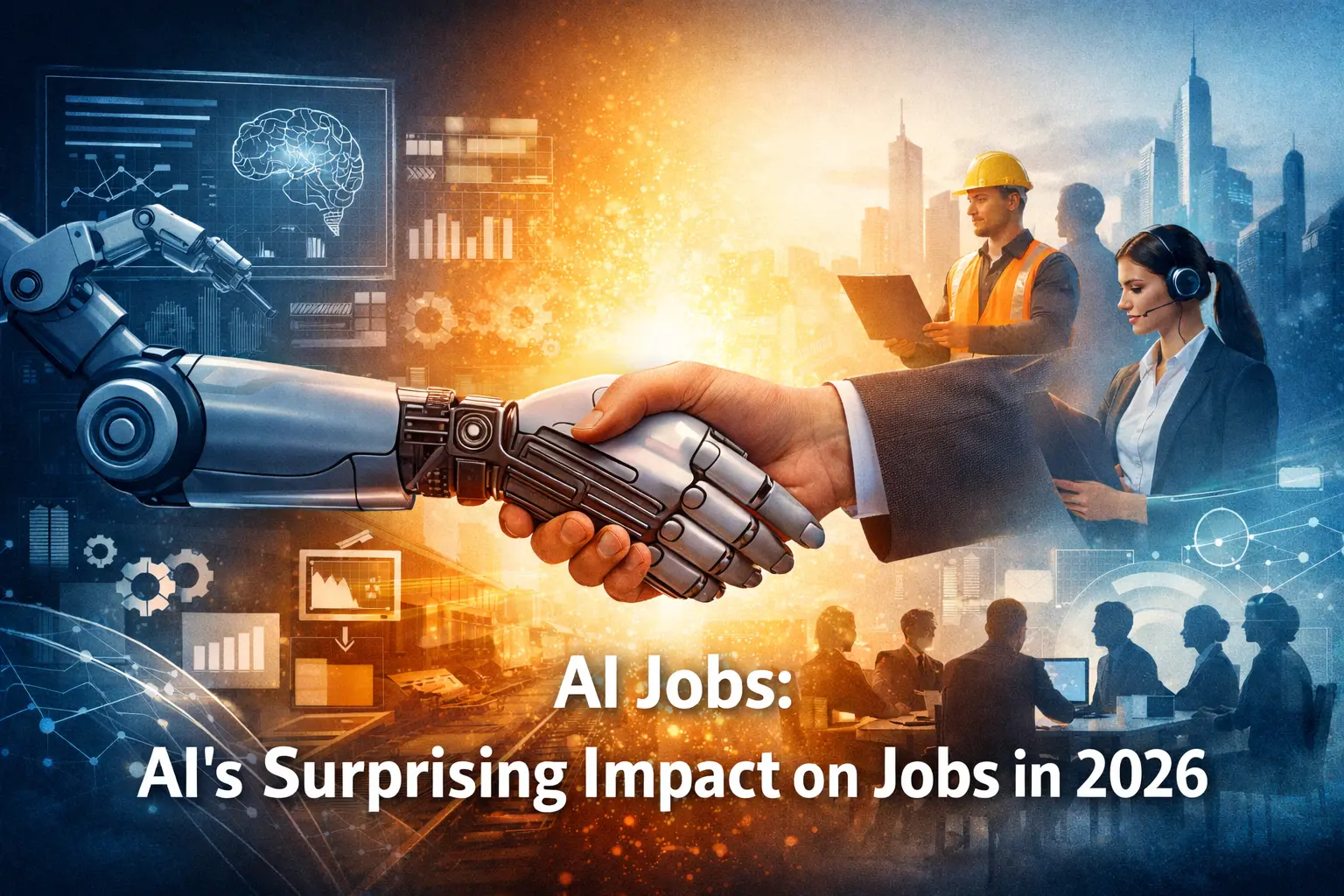
AI Jobs: AI’s Surprising Impact on Jobs in 2026
For years, AI jobs have been a major topic of discussion, as artificial intelligence was once seen as a serious threat to workers worldwide. There were predictions that machines would replace workers en masse and cause high rates of unemployment and economic dislocation. The real world is far from those early predictions as we get closer to 2026. Undeniably, AI has changed the workplace, but it hasn’t done away with people. Instead, labour has evolved in how it is performed and the skills required. Firms are now looking to AI to enhance their human workforce rather than supplant it. This result is surprising to both researchers and employees. The conversation now isn’t about losing jobs as much as it is about changing them. Knowing how AI actually affected the workforce matters for anyone trying to plan a career or run a business in today’s economy.

Early Fears About AI Replacing Human Workers
 Before AI was widely used, a lot of people thought it would cause widespread AI job losses. Warnings were issued that office jobs, customer service positions, and even creative work would vanish. These anxieties were grounded in AI’s capacity to perform tasks quickly and at a lower cost. While such concerns were inevitable, they tended to overlook the fact that jobs are complicated. Most jobs require human judgment, accountability, and communication—none of which AI can fully mimic. When AI came into the workplace, businesses discovered that doing away with humans altogether led to other issues, such as mistakes, poor customer service, and ethical hazards. It was increasingly evident by 2026 that early forecasts paid too much attention to automation and too little to how organisations really operate. AI turned out to be a powerful tool, but not a complete substitute for human labour.
What Actually Changed in the Workplace by 2026
In 2026, workplaces have changed, but they’re still focused on humans. “They use AI to do the boring, repetitive tasks so they can focus on higher-value work.” Instead of producing data by hand, employees evaluate insights produced by AI and make decisions. This has led to increased productivity without widespread job losses. The business community found that human intervention was needed for AI to give the best solutions. Instead of doing the tasks, employees wear the hats of supervisors, analysts, and decision-makers. This has led to increased productivity and less burnout in many fields. The true “destruction” of AI is not jobs being lost, but jobs being transformed. Workers who made the transition to this new paradigm found the roles themselves to be more engaging and rewarding than they had been.
How Entry-Level Jobs Have Been Transformed
Entry-level jobs underwent some of the most significant transformations due to AI. Before, these positions involved a lot of routine work, a lot of which AI can now complete in no time. Entry-level job listings in 2026 still exist, but the requirements have changed. New hires must employ the AI tools, interpret the results, and help make decisions further up the chain. While the skill bar has been raised, the pace of learning and career progression is now much faster. Young professionals are exposed to real complexity early in their careers. Nevertheless, the change also underscores the need for training and education. Those who lack access to learning opportunities may find it difficult. AI didn’t kill entry-level jobs, but it did dramatically change what it means to be a beginner in the workforce today.
Why Increased Productivity Did Not Cause Mass Layoffs
One of the most unexpected consequences of AI adoption is that higher productivity did not translate into mass layoffs. Several companies employed AI to increase productivity, not to trim headcount. Rather than shedding workers, companies widened offerings, enhanced quality, and reached more customers. Creativity, quality control, and customer relationships still require human participation. In reality, the organisations that sell out entirely on the cost curve are the ones that often encounter trouble down the road. Those that supplemented AI with human expertise did best. By 2026, it was already apparent that it was possible for both productivity and employment to increase. AI allowed workers to do more, not go away. This challenged the conventional wisdom that automation always destroys jobs.
New Job Roles Created by Artificial Intelligence
AI not only transformed existing jobs but also formed new ones. With the introduction of the more sophisticated systems within organisations, there were also people needed to run, supervise, and direct those systems. New positions include those related to the operation of AI and data management, as well as evolving roles in the management and supervision of systems. These roles call for a blend of technical know-how and human insight. They represent new possibilities for people who are willing to learn and change. This trend is nothing new; past technological revolutions triggered similar changes. AI is following suit, reshaping the job market rather than decimating it. The onus is on the worker to identify these new opportunities and arm themselves to pursue them through lifelong learning.
Why Human Skills Are More Important Than Ever
As technical activities increasingly shift towards AI, human skills are now more precious. Critical thinking, creativity, communication, and emotional intelligence will be more important to employers in 2026. It’s more than just data. This means that human participation is vital in such fields as leadership, medicine, education, and law. Employees with a combination of AI expertise and customer-facing skills are rare and in high demand. Instead of making humans redundant, AI has made it more obvious what makes them unique. The future of work comes down to people’s ability to learn these skills and then apply them with technology, not be replaced by technology.”
The Challenge of Skills Gaps and Adaptation
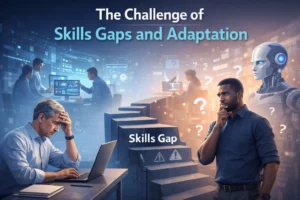
There are challenges, however, with AI, and one of those is the growing skills gap, which will be most visible in 2026. Not everyone has evolved with AI at the same rate. A few employees have little access to training or resources to help them adapt, and that presents a barrier to using new technology effectively. Others depend too much on AI and begin to question their own decisions and capabilities, leading to decreased confidence and productivity. This risks leaving parts of the workforce with outdated skills, resulting in inequality and inefficiency. Workers need to develop a mindset of continuous learning and skill acquisition if they want to keep their careers on track and succeed in the long term. Governments, educational systems, and employers all have a role to play in equipping workers for the AI-driven world. The problem is not AI—it’s under-preparedness and under-adaptation to the evolving workplace.
What Businesses Learnt From Using AI
By 2026, companies have realised that they need to adopt a responsible and considered approach to artificial intelligence. Early efforts to automate every procedure were the source of errors, inefficiencies and disgruntled employees and customers. Companies that jumped on the automation bandwagon too quickly often had to deal with operational issues, legal challenges and PR nightmares. Over time, proven organisations realised that a good AI system is one that augments and supports human decision-making rather than replaces it. It is true that human oversight is needed to intervene to avert disaster, mitigate bias and check for ethical compliance. That measured approach not only delivers better outcomes but also fosters greater trust and confidence among employees, clients, and shareholders. People who see technology and human being capabilities as equally important in their organisational culture would be naively optimistic to expect anything but growth and resilience over the long term. Its success requires intelligent implementation, strong leadership, and a culture that prizes not only innovation but human judgment.
Conclusion:
The effects of AI on employment in 2026 are less severe and more nuanced than some predictions suggested. Although there were widespread concerns some years ago that artificial intelligence would take human jobs, what we find today is that jobs have evolved, not been eliminated. People are now able to spend less time on dull, repetitive tasks and more time on meaningful work that is creative and human-centric, thanks to AI taking care of those tasks. This transition has increased productivity while maintaining human oversight. The future of work is not humans versus machines, but humans working together with machines. Employees with a growth mindset, who are open to change and willing to learn new skills, are best positioned to thrive in this evolving landscape. AI’s biggest surprise is how it has transformed work even as it underscores the value of human judgement, creativity, ethics, and decision-making. When harnessed appropriately, AI is a tool that augments people rather than replacing them and enables a more equitable and sustainable future of work.