
AI-Powered Self-Managing Enterprise Networks:
This has never been truer than in today’s digital age, where enterprise networks are critical to business success. Businesses depend on the internet, cloud infrastructure, and online communication to conduct day-to-day operations. Earlier, handling these networks meant a lot of manual work. Engineers had to watch systems, troubleshoot, and upgrade devices individually. It was a tedious process, and in many cases, companies experienced extended periods of downtime. Now, artificial intelligence is transforming that. Self-managing, AI-enabled enterprise networks can function and enhance themselves without (or with little) human input. These networks can identify issues early, automatically correct errors, and maintain optimal performance. As a result, several enterprises are now shifting towards AI-based networking solutions. This is a trend that’s gaining momentum and one that all IT practitioners, business executives, and virtually anyone who has ever been interested in technology should know about.

What Are AI-Powered Self-Managing Networks?
Autonomous networks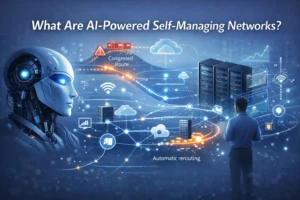 , be they self-managed or at least largely self-managed, use AI and ML to automate network operations. These networks can adapt traffic monitoring, speed, and connection handling in real time with little or no human intervention. When an issue arises, such as a slow connection or malfunctioning device, the system responds instantly and automatically remediates. For instance, if one route on the network is congested, AI can automatically reroute traffic to another route and maintain steady performance. This takes the pressure off IT teams and saves them countless hours. Engineers are enabled to focus on system enhancements and long-term growth planning. In a nutshell, these networks function as intelligent assistants taking care of daily technical chores, enabling businesses to keep running efficiently without incessant oversight.
Why Self-Managing Networks Are a Trending Topic Today
Self-managing, AI-enabled networks have been gaining momentum as enterprises innately face more challenges that need to be addressed. Today, organisations rely on cloud services, remote work applications, IoT devices, and web-based solutions on a daily basis. Managing all these systems manually has become extremely challenging. AI makes this easier by automatically taking care of these mundane jobs, such as monitoring, updates, and troubleshooting. Another factor in the hype surrounding the topic is the global shortage of qualified IT workers. Many organisations face a shortage of skilled IT professionals capable of managing increasingly complex networks. AI is helping to bridge the gap by automating repetitive tasks. There are also growing cybersecurity threats each year, requiring businesses to adopt smarter security measures. AI networks can identify anomalies in real time and react more quickly than traditional approaches. Enterprises are thus now increasingly viewing self-managing networks not simply as smart business but as a vital investment in the running of day-to-day operations.
How AI Helps Networks Work Automatically
Thanks to artificial intelligence, networks can be intelligent and make decisions by themselves. One key capability of AI is uninterrupted, real-time network monitoring. It is a continuous process of monitoring network traffic, device behaviour, and performance to establish a baseline of what is considered normal. Second, AI enables self-optimisation. In case one segment of the network becomes congested, the traffic can be load-balanced by the system automatically diverting traffic to different routes. Another key capability enabled by AI is self-healing. When a device goes down or a connection is lost, the network detects the problem and fixes it without any human involvement. Lastly, AI adds security. It identifies abnormal network behaviour that may indicate cyberattacks, automatically blocks threats, or immediately notifies administrators of such threats. Together, these features help make networks faster, more dependable, and more secure.
Key Technologies Behind Smart Enterprise Networks
A number of technologies are enabling AI-enabled self-managing networks. Machine learning is the most important. It enables networks to make decisions based on historical data and to adapt their decisions at run-time. Another relevant technology is AIOps (Artificial Intelligence for IT Operations), which supports the management of hierarchical IT systems by mitigating the number of alerts for IT administrators and automating problem rectification. Intent-based networking is also important. Here, administrators define objectives such as prioritising video calls, while the system automatically determines the technical implementation. Network automation tools handle all updates, backups, and configurations — eliminating manual labor. These technologies combine to provide networks that are increasingly self-sufficient, responsive to changing needs, and able to unlock human capacity.
Benefits of AI-Powered Self-Managing Networks
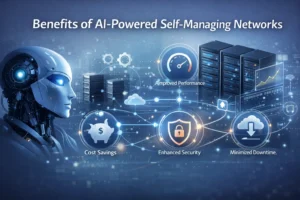
Self-managed networks enabled by artificial intelligence offer numerous advantages to enterprises. Cost savings are one in a long list of benefits. Self-managing networks reduce the need for day-to-day hands-on work by firms, leading to lower costs. Another key benefit is the consistent improvement in system performance. The network automatically adjusts its speed and traffic to provide reliable, high-speed connections for employees and customers. AI improves security as well, since it can detect threats earlier than traditional systems and protect sensitive data. And the system now also minimizes downtime by addressing issues rapidly, often unbeknownst to the users. These benefits have a proactive effect on customer experience, operational efficiency, and business growth over time. In the long run, (business-to-business) AI networks also offer scalability, enabling enterprises to grow without extensive manual network modifications.
Real-Life Use of Self-Managing Networks in Businesses
Many industries have already adopted AI-based self-managing networks. Large multinationals manage tens of thousands of devices with AI across multiple sites. Those networks are what hospitals use to run critical patient systems without jarring downtime. Manufacturing companies now widely adopt smart networks to link machines, monitor production lines, and reduce waiting times and power outages. AI-led networks also protect data and prevent fraud in banks and financial institutions. These examples demonstrate that self-managing networks are not a future concept but are already delivering real operational value across industries. From financial services to manufacturing to healthcare, companies in all sectors are reaping the rewards of AI-powered automated monitoring, optimisation, and security, and delivering on the promise of the technology to be both practical and invaluable.
Challenges of AI-Based Enterprise Networks
However, there are some challenges in AI-enabled networks. One obstacle is the upfront cost, since these systems demand purchasing tools, training, and infrastructure. Another problem is data quality. AI makes decisions, but it requires correct and clean data to make them accurately; feeding it incorrect data will produce wrong AI-driven actions. Some IT professionals remain cautious about fully trusting automated decision-making systems, fearing that they are handing over too much control to automated systems. It is important to protect the AI systems at the core as well because an attacker may attempt to compromise the AI infrastructure. Despite the challenges, experts agree that potential benefits are far greater than risks over the long run. Adequate planning, supervision, and training efficiently address a majority of these problems.
How Self-Managing Networks Are Changing IT Jobs
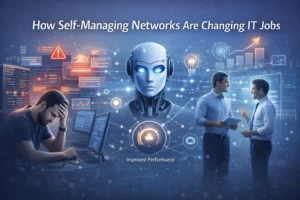 AI-enabled networks are actively transforming IT roles and responsibilities. Historically, IT groups used to spend the bulk of their time troubleshooting and reacting to alerts. Today, much of the day-to-day work is done by artificial intelligence, and IT personnel can focus on innovation, strategic planning, and using technology to enable the business. Autonomous networks will increasingly turn IT organizations from reactive firefighting to proactive technology strategy, with IT pursuits tightly coupled to business targets.
The Future of Enterprise Networking with AI
AI and automation are actively evolving enterprise networking into a fully automated and intelligent system. Networks will not only repair themselves but also make decisions informed by business requirements in the next few years. For instance, when a company releases a new online service, the network can automatically provision extra resources. These systems will learn continuously from data and improve as time evolves. They expect future networks to also integrate closely with AI in security, customer service, and data management to weave fully intelligent, interconnected ecosystems. AI-powered self-managing networks are much more than simply trending; they’re fundamentally changing what it means for businesses to operate efficiently, securely, and competitively.
Conclusion:
Autonomous, AI-driven networks are rapidly becoming a competitive necessity rather than a technological luxury. They enable traditional networks to become intelligent systems that can automatically monitor, protect, optimise, and even remediate themselves. Today’s businesses have hard-to-manage infrastructures, are under threat from cyberattacks, and have to provide always-on connectivity. AI automation assists in cost saving, performance improvement, and security enhancement, as well as in the reduction of downtime. They also free IT professionals to focus on strategy, innovation, and driving business growth instead of routine operational tasks. With these advantages, AI-enabled self-managing networks are definitely one of the most compelling, usable, and hottest topics in enterprise technology. Early adopters of this enterprise technology will win big, as it enables them to communicate less, solve problems faster, and prepare more effectively for the digital future.