
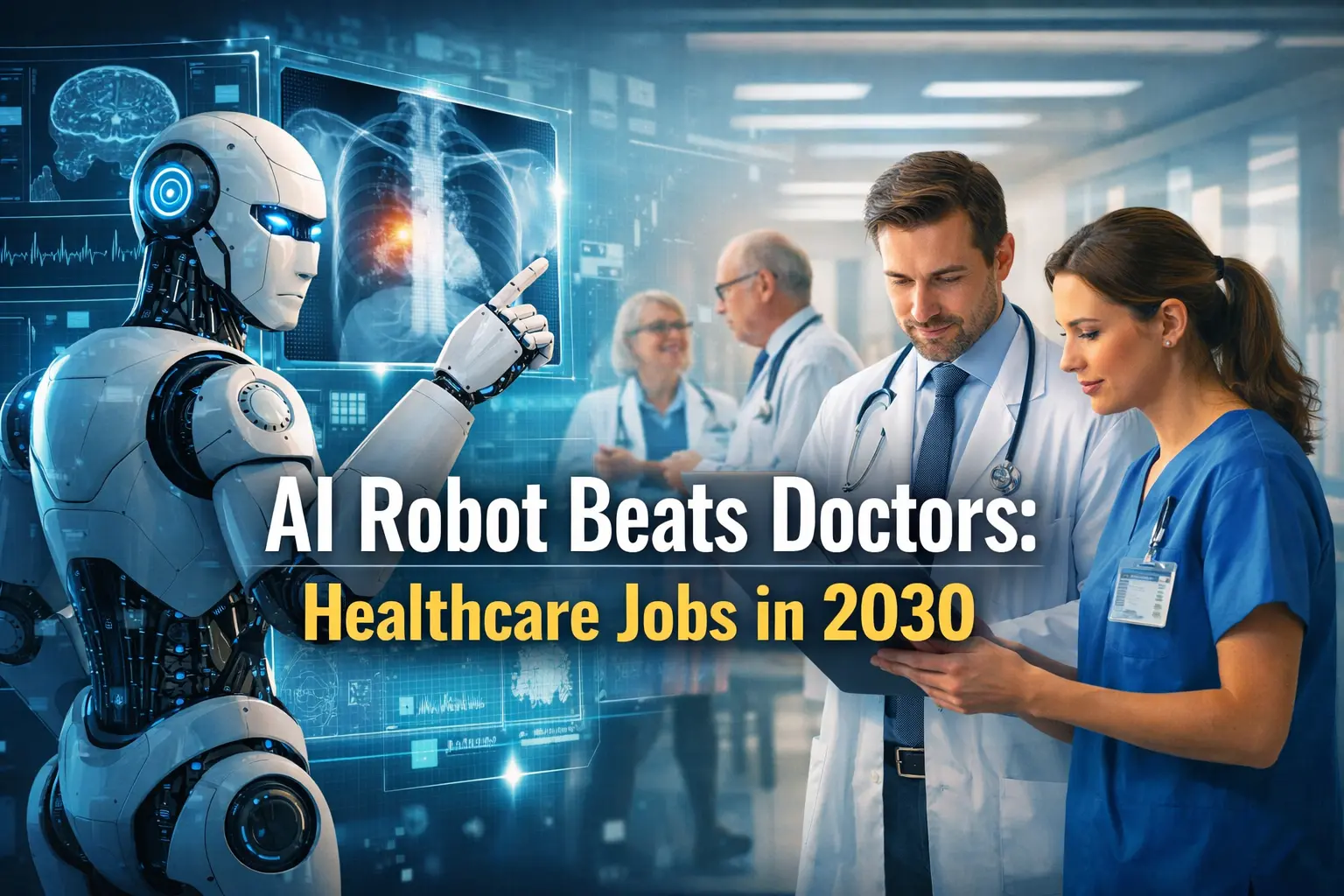
AI Robot Beats Doctors: Healthcare Jobs in 2030
Artificial intelligence (AI) has become an integral part of our everyday life after being a technological fantasy for a long time. It powers our smartphones, personalizes our shopping, and is now poised to revolutionize one of the most important sectors of society – healthcare.
AI-enabled systems have recently been able to outperform human doctors in the task of diagnosing certain diseases, sometimes doing it in the blink of an eye. Such a revelation has generated a mixture of excitement and fear. This leads to a critical question: how will the lightning speed of AI impact healthcare jobs by 2030? Will AI technologies displace doctors and nurses, or will they merely be the tool that boosts their greatest power?
The article unpacks the reality of the ongoing AI revolution in the healthcare sector and what it essentially means for the workforce caring for our health.

How AI Robots Diagnose Diseases So Fast.
AI machines are not identical to human beings in their functioning. They never get tired, get emotional, or stressed. They work with data. These systems are trained on millions of medical records, test results, scans, and reports collected from hospitals around the world. When a patient’s information is given to an AI system, it can:
Analyze symptoms instantly Compare the case with millions of similar cases
Within a few seconds, have the ability to visualize and interpret X-rays, CT scans, and MRIs.Find tiny signs of disease that humans may miss. For example, AI systems are already very successful at detecting cancer, heart disease, and lung problems. In some tests, AI has been more accurate than experienced doctors. While a doctor may need time to study reports, AI can give results almost immediately. This speed is the reason why people say “AI robots beat doctors in seconds.”
Why AI Is Sometimes Better Than Humans
Doctors are very skillful, but after all, they are humans.
They can be exhausted after long working hours, err in difficult situations, or overlook tiny details.
AI does not have these problems.
AI is better at:
Handling large amounts of data
Remembering every medical case that has been learned
Keeping focus for many hours
Giving consistent results
On the other hand, a faster performance is not an indication of completeness. AI may be able to analyze data, but it still does not have the capability to comprehend or share people’s feelings, fears, or pain.
Does This Mean Doctors Will Lose Their Jobs?
This is the biggest fear. The straightforward answer is no, doctors won’t be extinct. Doctors are not only diagnosing diseases, but they are much more than that. Communicate with patients and families, understand emotional and mental health
Decide ethically , build trust with patients
Artificial intelligence is not able to substitute human feelings, concern, and social interaction. Artificial intelligence is becoming a work tool that facilitates the work of doctors, thus helping them to work better and faster, instead of replacing them. It will be a case in point by 2030 when doctors skilled in AI utilization will be worth more than any other doctors.
Healthcare Jobs That Will Change by 2030
Several healthcare occupations will be modified due to AI. It implies that these jobs will not be eliminated, but their characteristics will be altered.
Radiologists
The primary task of a radiologist is to study and explain the medical images, like X-rays, CT scans, MRIs, and Ultrasounds.
It is one of the fields where AI has a lot of power.
By the year 2030:
AI will read images first
Radiologists will confirm results
Humans will handle complex cases
Radiologists will work with AI, not against it.
Medical Data Entry Jobs
AI can automatically record and organize patient data. This may reduce simple data entry jobs, but new technical roles will appear.
Laboratory Work
Skills laboratory personnel proficiently perform an essential function by looking after automated experiments and dealing with abnormal cases.
Healthcare Jobs That Will Grow in the Future
As healthcare facilities upgrade their technologies and processes, some jobs will stay the same, but a lot of healthcare roles will experience a growth in demand.
Doctors and Specialists
Doctors who understand AI tools will diagnose faster and treat more patients. AI can reduce the amount of work and the volume of stress.
Nurses
Nurses are the ones who give care, comfort, and help. Artificial intelligence will never be able to replace human care.
Mental Health Professionals
AI cannot fully understand emotions. Professional psychologists, therapists, and counselors will be absolutely necessary.
New AI-Related Healthcare Jobs
New roles will appear, such as:
Medical AI specialists
Healthcare data analysts
AI system trainers
AI ethics officers
Skills Healthcare Workers Will Need by 2030
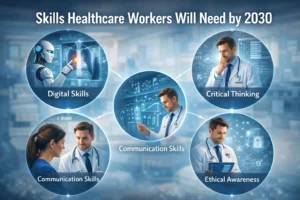
To stay relevant and thrive, healthcare workers must acquire new skills.
Digital Skills
Medical professionals, along with nursing staff, ought to be proficient in the operation of AI systems, the interpretation of AI reports, and collaboration with digital records.
Critical Thinking
AI can suggest various alternatives; nevertheless, the final decision is still made by a human.
Communication Skills
They require outstanding communication skills to be able to convey the AI-assisted diagnoses as well as the complicated treatment plans to their patients in a very clear and empathetic way.
Ethical Awareness
First of all, healthcare workers must be very careful when they deal with patient privacy, data protection, and the ethical aspects of AI systems.
Benefits of AI for Patients
AI is not only about jobs. It also brings many benefits for patients.
Faster Diagnosis
Early detection is what saves lives. Artificial Intelligence is able to identify diseases that have not yet become severe.
Lower Costs
Automation reduces hospital expenses, making healthcare more affordable.
Better Access
People in rural or poor areas can receive AI-based medical support where doctors are limited.
Fewer Errors
Artificial intelligence reduces mistakes that are caused by weariness or stress.
Risks and Challenges of AI in Healthcare
AI is, in any case, somewhat difficult to handle in those areas that demand care.
Data Privacy
Medical data is extremely sensitive. Patient information requires healthcare providers to have robust security.
Over-Reliance on AI
Doctors should not blindly trust AI. Human judgment is always necessary.
Bias in AI
Restricting the data for AI training may lead the system to generate biased outcomes for some groups.
Fear Among Workers
Many healthcare workers fear losing jobs, which creates stress and uncertainty.
What Medical Students Should Do Today
Students planning a medical career should not panic. Instead, they should prepare.
They should:
Learn basic AI knowledge
Stay updated with technology
Focus on patient care skills
Choose specialties that combine technology and human interaction
The future is for those professionals who keep on changing.
The Future of Healthcare: Humans and AI Together
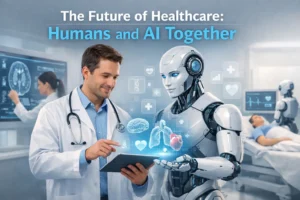
In 2030, the health care system is going to look quite different from what we have today. AI robots will be the helpers of doctors, not the competitors detect illnesses in the blink of an eye, enable more effective treatments, and make healthcare organizations highly efficient. So the main difficulty doesn’t lie in AI technology itself but rather in our capacity to incorporate it into healthcare ethically and efficiently. There is a popular saying that perfectly suits this situation: “AI will not replace doctors, but rather doctors who use AI will replace those who do not.”
Conclusion.
In fact, the health care systems that will be top-performing in 2030 would not be ones that are either completely AI or human-centered, but those that will have an appropriate mix of both. Since AI is very efficient, it will be able to go through data-driven tasks at an extremely fast speed and with great accuracy; therefore, there will be fewer errors, and also the load of the administration will be reduced.
Therefore, medical staff such as doctors, nurses, and technicians will be able to continue their work of medicine that no machine can ever replace: making complex decisions, communicating compassionately, and being of an ethical nature. It is not a competition but a coexistence that brings out the best in both partners.
Once it is said that AI will never be able to replace human doctors, still, those doctors who are supported by AI will be way more successful than unassisted ones. The healthcare of tomorrow is a symbiosis that ensures better patient wellbeing on the one hand and more fulfilling roles for those professionals who serve the patients on the other hand.”