
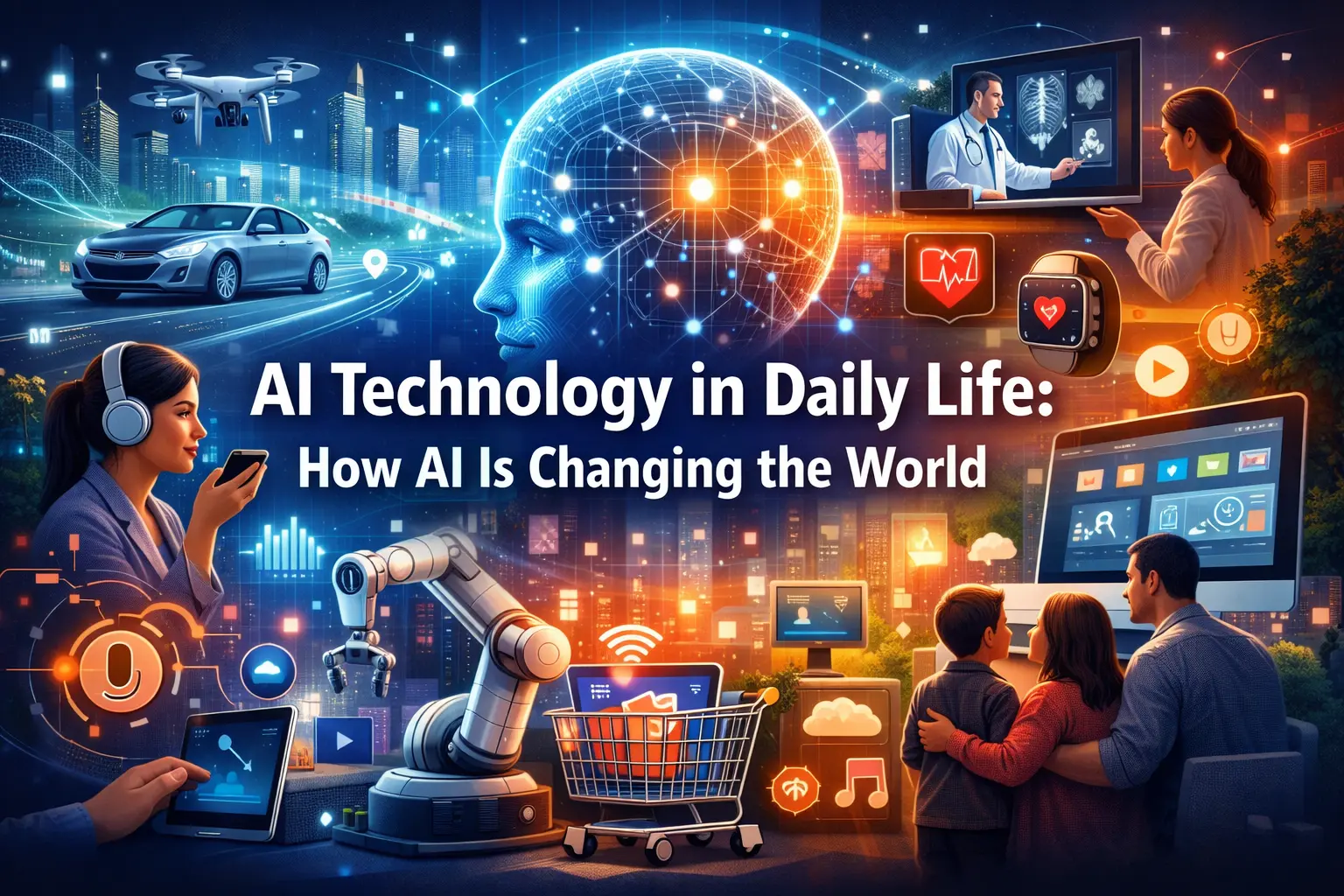
AI Technology in Daily Life: How AI Is Changing the World
Artificial Intelligence (AI) has permeated our everyday life in such a way that it has stopped being just a future concept. This is now a reality we use every day. In many cases, unaware that it is happening, we interact with it.
. For instance, AI is there assisting us when we are browsing through customized social media feeds, requesting navigation, buying products online, or watching videos based on the algorithm’s suggestions. It, thus, goes a long way to increase productivity, improve accuracy, and make the execution of everyday tasks quite easy. The article here discusses Artificial Intelligence in daily life to see how it becomes a natural element of our life, and also how it is not only reshaping our habits but actually changing our way of life.

What Is Artificial Intelligence?
Artificial Intelligence (AI) refers to a wide range of systems/machines that have some capabilities of human-like intelligence, such as the ability to reason, learn, and make decisions. Nevertheless, these machines or systems have no feelings; on the contrary, they can analyze the data that they have been given, recognize the patterns in it, and make decisions on the basis of such patterns.
Therefore, their performance is getting better with time.
For example, one of the simplest Artificial Intelligence examples is if your device suggests the next word you are going to write, or if a video-sharing site recommends you the content to you based on your preferences.
Here, AI is functioning secretly. It tracks and stores your behaviors and then uses the data to give you more personalized and accurate results from now on.
Basically, AI can be defined as a technology that allows machines to gain knowledge through learning and experience.
AI in Smartphones and Personal Devices
Smartphones are undoubtedly the most common platforms that make it possible for people to communicate with AI, essentially everywhere. So many features on AI smartphones are, in essence, various AI technology manifestations. Among these features can be facial recognition, voice assistants, camera improvements, and predictive text. Siri, Google Assistant, and Alexa are voice assistants that can understand and process human speech. Moreover, instant answers can be obtained by simply asking questions. In addition, voice assistants are very versatile as they can even do such tasks as creating a reminder, sending a message, browsing the internet, and controlling house devices. Through users’ operations, the assistants learn and thus become more personalized and proficient. In addition to that, AI is an effective instrument in smartphone photography; it can fix pictures that have been taken in undesirable light conditions. It is also capable of improving the quality of an image and even auto-detecting the person’s face for focusing. So, essentially, anyone can become a great photographer without having to learn any special skills
AI in Smart Homes and Daily Comfort
AI technology has significantly enhanced the lifestyle of a household by making it intelligent, safe, and energy-efficient. Smart living devices are capable of understanding the user’s daily life and thus can react appropriately. For instance, smart lights can go on and off without the necessity of manual operation, the thermostat can change the temperature by predicting the weather and its usage pattern, and the security AI system, on the other hand,d can spot unusual activity,s making the homeowner get a warning immediately. Besides, some systems can even recognize faces that they have seen before. By enabling a person to carry out their daily activities with more comfort, these technologies have played a significant role in saving energy, and they give people a feeling of security and mental relaxation.
AI in Healthcare: Improving and Saving Lives
AI significantly changes healthcare, which is one of the most powerful sectors. It allows doctors to better interpret medical images, lab results, and patient records in great detail. AI can now commonly detect early signs of cancers and heart diseases when they are most treatable. In addition, manufacturers embed AI into smartwatches and other wearable technologies. These devices not only measure heart rate but also track sleep quality and analyze workouts. Health monitoring, therefore, becomes something we do without thinking. AI virtual assistants have the potential to provide multiple healthcare-related services such as delivering health information, reminding of medication, booking appointments, and thereby they can lessen the workload of healthcare professionals.
AI in Education: Smarter and Personalized Learning
Artificial intelligence completely transformed education. AI in educational platforms can figure out how a student learns and change the lessons to the student’s pace without human intervention. However, if a student is struggling with a certain topic, AI will keep giving them practice problems, which is incorrect.
It skips the next section and proceeds if the student can learn quickly. Consequently, this personalized method enables students to grasp ideas more easily and keeps them inspired. Educators, too, have anedge over their colleagues who do not have AI-driven technology in that they can effectively monitor their students’ progress, recognize the areas where the students are lacking, and plan their lessons in a more efficient way by using these teacher assistants. Thus, the education of today has turned out to be more adaptable, more accommodating, and more productive.
AI in Workplaces and Business
Artificial Intelligence (AI) has transformed the entire world of offices and businesses in different parts of the globe to a huge extent. At present, company executives depend on AI for data analysis, customer service improvement, and decision-making accuracy. Customer service bots are always ready to answer repetitive queries. AI applications are not only limited to helping with emails and calendar but they also go as far as refreshing reports and forecasting trends in markets. Human errors are kept at a minimum because of such time-saving devices as well. Automation is a change agent in the labor market, but on the other hand, AI brings about new jobs in the areas of data analytics, programming, and tech management. Generally speaking, AI is just a helper to humans and not their competitor.
AI in Transportation and Travel
Transportation has become more intelligent and safer thanks to AI. AI powers navigation apps to track traffic in real time and recommend the quickest ways. Taxi-hailing services use AI to efficiently match drivers and passengers. Car producers at present
equip newly produced automobiles
It has features with AI, such as parking assistance, lane control, and collision warning. Self-driving technology is still very new, but it can definitely help to decrease the number of accidents and increase road safety.
AI in Entertainment and Media
One of the changes AI has made to entertainment is making it more personalized. For instance, streaming services suggest movies, series, and tracks according to the users’ likes. Artificial intelligence also has a great impact on video games by giving game characters a high level of intelligence and designing lifelike settings. The film and music industries benefit from AI technology in various production processes, such as polishing, sound creation, and the generation of visual effects. Applications like Facebook, Twitter, and others use artificial intelligence to recommend content, identify and remove hate speech, and provide a better experience to their users.
AI in Shopping and Everyday Buying
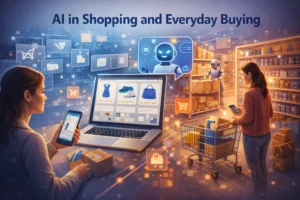
Thanks to AI, shopping online has become a more personal experience. For example, when a site proposes products that seem right for you, it is actually AI that, behind the scenes, studies what you look at and buy.
Have you ever wondered how some online stores always seem to have a ready answer for you? It is actually an AI-powered chatbot that helps you not only with your inquiries but also with placing orders and returns. Moreover, companies utilize AI to control stock and optimize delivery workflows in a more sustainable way. Among other things, AI based on customer behavior recognition and analysis makes it possible for stores to get rid of cashiers, thus allowing shoppers to have a quick and seamless shopping experience in a physical store.
Challenges and Ethical Concerns
Artificial intelligence has indeed ushered in a multitude of benefits for us. Nevertheless, it is not without its perils. One of the biggest issues is privacy because AI technologies are primarily based on gathering and analyzing an enormous amount of personal data.
Data misuse might result in very bad outcomes. On top of that, there is a risk of bias. When AI algorithms use only partial or unfair data for their training, they can also make biased choices. That is the reason why we should have human control, ethics, and laws to support AI systems. Everywhere, from governments to businesses, people are thinking and putting in place strategies to ensure the proper use of artificial intelligence.
The Future of AI in Daily Life
The future of AI holds many possibilities. In future smart cities, AI will administer various urban systems. It will manage traffic flow to prevent congestion, regulate power consumption for greater efficiency, and optimize public amenities like lighting and waste collection. Besides, healthcare will become more predictive and customized. Education will keep changing to fit individual learning requirements. AI could assist a lot in solving international issues such as climate change, disaster management, and food security. Still, it is vital that human help is there to make sure that the benefits of AI are for all.
Conclusion
AI technology has become so close to us that nowadays, we cannot imagine being without it. With the use of AI, not only are our work processes streamlined, but we also gain new information faster, take care of our health, and enjoy our leisure activities in a more convenient way. Despite some difficulties, AI, when used ethically, will probably bring about a more effective and interrelated world. Learning about AI has become a must. People who master the skill of AI usage will be more forward-looking and will be able to seize the benefits that come with it.