
Elon Musk’s Vision: The Role of AI in SpaceX’s Journey to Mars
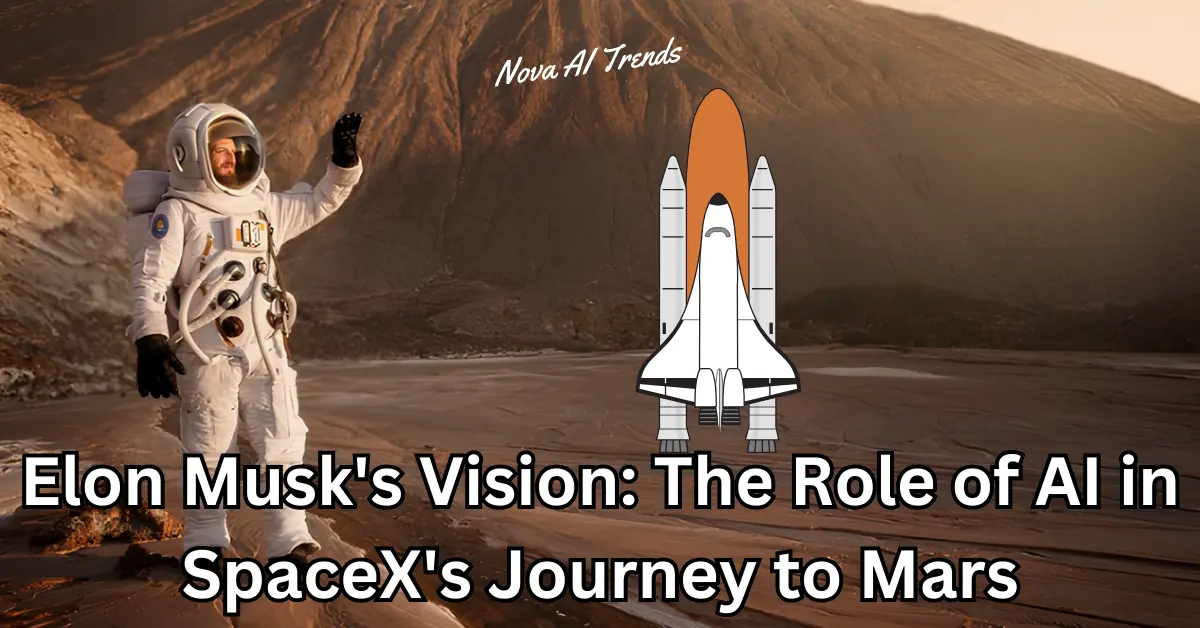
Elon Musk, the visionary business manager behind SpaceX, Tesla, Neuralink, and the Boring Company, has long clutched a goal to colonize Mars. Crucial to this vision is the coordination of AI into the swarm difficulties connected with interplanetary travel and colonization. AI stands to assume a basic part in SpaceX’s aggressive Mars mission, from planning rocket and improving coordinated operations to guaranteeing group security and overseeing life emotionally supportive networks. This article investigates how AI is vital to SpaceX’s excursion to Mars, clarifying the different features that AI adds to making interplanetary colonization a reality.

The Vision of Mars Colonization
 Elon Musk’s vision for Mars colonization is established in his conviction that humanity should turn into a multi-planetary animal category to guarantee its endurance. Musk imagines a self-supporting settlement on Mars, fit for supporting a significant human populace and flourishing freely on Earth. The progress of this vision depends on defeating huge specialized, strategic, and human difficulties, a substantial number of which can be tended to through cutting-edge AI innovations.
AI in Spacecraft Design and Engineering
Perhaps the earliest and most basic strides in the journey to Mars is the plan and designing of a shuttle fit for making the outing. AI is instrumental in this stage, offering progressed computational capacities to display, recreate, and enhance rocket plans. Machine learning algorithms can investigate immense measures of information from past missions, distinguish designs, and propose plan upgrades that improve security, proficiency, and cost-viability.
For example, AI-driven recreations can anticipate how different shuttle materials will act under the outrageous colony of room travel. These reproductions assist engineers with choosing the most reasonable materials and foundational layouts, limiting the gamble of disappointment during the mission. Also, AI can enhance drive frameworks, guaranteeing the greatest effectiveness and unwavering quality for the long journey to Mars.
Autonomous Navigation and Landing
Exploring through space and landing on another planet are among the most intricate parts of any space mission. AI is pivotal in autonomous navigation and landing systems, empowering rockets to pursue constant choices in light of sensor information. SpaceX has proactively shown the adequacy of AI in this area with its autonomous landing systems for Falcon rockets.
For Mars missions, AI-driven navigation systems can examine the rocket’s direction, change its course on a case-by-case basis, and guarantee an exact landing at the assigned site. These frameworks depend on AI calculations that interact with information from different sensors, including cameras, LIDAR, and radar, to make a point-by-point guide of the Martian surface and distinguish the most secure landing spots. Via mechanizing these basic errands, AI decreases the gamble of human blunder and improves the probability of an effective mission.
AI and Robotics for Exploration and Construction
 When on Mars, laying out an economic settlement requires broad investigation and development endeavors. AI-powered robots will be at the front of these exercises, leading to excessively perilous undertakings or work concentrated on human space travelers. These robots outfitted with cutting-edge AI algorithms, can independently explore the Martian territory, gather tests, and lead logical investigations.
As far as development, AI-driven robotics can collect living spaces, fabricate frameworks, and set up life emotionally supportive networks. For example, robots furnished with AI can construct solar panel arrays to harness energy from the Sun, set down correspondence organizations, and assemble defensive sanctuaries to safeguard people from the cruel Martian climate. These robots can work consistently and with high accuracy, speeding up the advancement of the colony and diminishing the requirement for human mediation.
Life Support and Resource Management
Keeping a steady and manageable life emotionally supportive network is basic for the endurance of space explorers on Mars. AI can enhance life’s emotionally supportive networks by observing and directing ecological circumstances like temperature, moistness, and air quality. Machine learning algorithms can dissect information from sensors implanted in natural surroundings and change framework boundaries to guarantee ideal day-to-day environments.
Asset the board is another region where AI can have a tremendous effect. AI can supervise the utilization and reusing of assets like water, oxygen, and food, guaranteeing that these assets are utilized proficiently and reasonably. For example, AI algorithms can screen the development of harvests in Martian nurseries, changing lighting, watering, and supplement levels to amplify yield. By enhancing assets on the board, AI makes a self-supporting environment that can uphold human existence on Mars.
AI in Health Monitoring and Medical Support
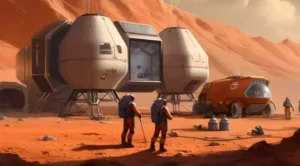 The health and well-being of space travelers on a long-span mission to Mars are foremost. AI can assume an essential part in checking the strength of team individuals and offering clinical help when required. Wearable sensors can ceaselessly follow essential signs, and AI algorithms can investigate this information to recognize any oddities or medical problems right off the bat.
AI-powered diagnostic systems can help with distinguishing ailments and suggesting treatment choices. In case of a crisis, artificial intelligence can direct space travelers through operations, offering bit-by-bit guidelines and guaranteeing that they have the vital help to deal with clinical circumstances without a human doctor.
AI for Data Analysis and Decision Making
The tremendous measure of information created during a Mars mission requires refined instruments for examination and independent direction. AI succeeds in this area, fit for handling and breaking down huge datasets to remove significant bits of knowledge. For instance, AI can examine land information gathered by wanderers to recognize likely destinations for asset extraction or logical exploration.
AI can likewise help mission organizers in settling on informed choices by reproducing various situations and anticipating their results. These reenactments can assist with distinguishing expected gambles and foster alternate courses of action, guaranteeing that the mission stays on target even despite unforeseen difficulties.
Ethical Considerations and Challenges
While AI offers various advantages for Mars missions, it additionally raises significant moral contemplations and difficulties. The dependence on AI for basic dynamic cycles requires guaranteeing the straightforwardness and responsibility of AI frameworks. It is fundamental to foster powerful structures for AI governance, guaranteeing that AI frameworks work in a way that lines up with human qualities and moral standards.
Also, the combination of AI in space missions raises worries about the likely loss of human abilities and aptitude. As AI takes on additional undertakings customarily performed by people, it is urgent to offset computerization with the requirement for human contribution, guaranteeing that space travelers hold the abilities and information expected to deal with unanticipated circumstances.
The Future of AI in Space Exploration
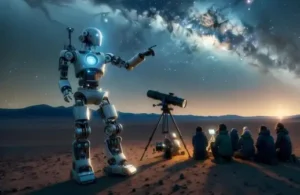 The journey to Mars addresses only the start of AI’s role in space exploration. As AI innovations keep on propelling, they will empower progressively aggressive missions, including the exploration of external planets and, surprisingly, interstellar travel. Also, AI-driven systems are advancing to turn out to be more independent and refined, in this way pushing the limits of space exploration capacities. They are increasingly independent, perceptive, and adept. This further expands the horizons of what can be achieved in scientific inquiry beyond Earth. The eventual fate of space exploration looks encouraging. AI will assume a critical part in defeating the difficulties of profound space missions. These progressions in simulated intelligence upgrade how we might interpret the universe. They also pave the way for human settlements on other planets.
Elon Musk’s vision for Mars colonization underscores AI’s remarkable capacity to comprehend humanity’s aspirations to explore and inhabit diverse universes. This ambitious endeavor exemplifies the synergy between technological innovation and human curiosity. By utilizing AI, SpaceX can overcome the colossal challenges of interplanetary travel. Furthermore, it can establish a thriving human presence on Mars. As we plan, the collaboration between AI and space exploration vows to open new frontiers. Furthermore, it will redefine our place in the universe.
Conclusion
Elon Musk’s vision of colonizing Mars is a venturesome objective that requires defeating various specialized and strategic difficulties. AI remains an essential empowering agent in this stupendous undertaking, offering advanced capabilities for rocket designs and autonomous navigation. Additionally, it enhances robotics, life support, well-being observation, data analysis, and decision-making. The integration of AI into SpaceX’s Mars mission marks a huge leap forward in space exploration. Moreover, it prepares humanity to become a multi-planetary species. As we continue pushing the limits of innovation and exploring the universe, AI will stay at the forefront. It drives development and makes the fantasy of interplanetary colonization a reality.