
How AI Is Quietly Fueling a Comeback in Entry-Level Jobs
Artificial intelligence has long been considered the main culprit that will take away entry-level jobs, those in customer service, data analysis, basic coding, and administrative work, for example. On the one hand, experts have been warning that automation would do away with these kinds of jobs, thus leaving graduates and young professionals with fewer opportunities to start their careers. On the other hand, a surprising change is happening now. The CEOs of public companies, while they admit that AI is changing the way work is done, they, however, indicate another less obvious trend that it is, in fact, increasing the need for junior staff. To a great extent, AI is able to handle routine work efficiently, but on the other hand, it is also opening up different kinds of jobs that need human judgment, oversight, and adaptability. Consequently, firms are coming to the realization of the importance of early-career talent in an AI-influenced world.

Rethinking AI’s Impact on Jobs
 The initial round of AI rollouts heavily focused on cutting costs and improving efficiency. To make operations faster, firms turned to automation, thereby achieving headcount reductions as well as the elimination of monotonous jobs. Predictably, the rate of new hires decreased—particularly for low-level positions that were most straightforward to automate. Managers realized a key truth: for AI to be effective, it still fundamentally requires human oversight.“AI instruments are a great power, but still, they require human beings to oversee them,” a CEO of a publicly traded company said during an earnings call.
“They need people to review outputs, correct errors, apply context, and ensure responsible use.”Such a shift in thinking has led companies to make a strategic turn. Presently, many companies are redesigning these roles so that new hires can collaborate with AI, rather than eliminating the positions. Hence, there isn’t a loud hiring frenzy; instead, the return is slow and prudent.
Why Entry-Level Talent Is Gaining Value Again
There are several important reasons that explain the renewed demand for junior hires.
AI Generates New Responsibilities
On the one hand, AI is helping to lessen the workload that is more routine in nature; on the other, it is bringing with it a whole set of new tasks that have never existed before. It is necessary to verify that AI-generated outputs are accurate, unbiased, and conform to the set standards. Models need continuous feedback. Prompts must be refined, and edge cases require human judgment. This kind of work rarely requires 20 years of experience. Top managers report that tech-savvy, fast-learning junior employees perform these AI-augmented roles most effectively. Executives note that younger staff often grasp AI-driven workflows faster than those trained in traditional methods.
Cost Efficiency Meets Productivity
Cost discipline remains the top priority, even as companies invest billions in AI infrastructure. The cost of a big hire of senior specialists to handle AI systems might be quite high. Entry-level talent offers a more scalable and economical solution. Many CEOs now describe a “lean core” workforce strategy: smaller leadership teams supported by AI-augmented junior employees. AI tools help entry-level employees produce more, narrowing the gap between junior and mid-level roles.
AI Lowers the Experience Barrier
 Traditionally, a lack of experience limited entry-level employees .AI is changing that dynamic. As a result of AI copilots and decision-support tools, employees at the junior level are able to carry out operations that were for the most part of the senior staff. Marketing associates have the capability to analyze the campaigns deeply, graduates in finance are able to create complicated models, and customer support agents can handle complex issues with the help of AI.CEOs increasingly say this “experience compression” makes hiring entry-level talent more attractive, as new hires become productive faster than ever before.
Executives were once reluctant, but now acknowledge this shift as an open secret in earnings calls and conferences.
Technology CEOs emphasize that the development of AI systems requires human intervention in testing, supervision, and responsible deployment. Retail and logistics executives mention the case of junior analysts who keep an eye on AI-driven demand forecasts and supply chains. Financial services leaders make a point of entry-level staff reviewing AI-generated outputs for regulatory and ethical compliance. Few CEOs call it a hiring surge, but most agree it marks a major shift in workforce planning. According to them, AI is not taking away entry-level jobs but rather transforming them.
A New Kind of Entry-Level Role
The entry-level positions returning today look very different from those of the past.
Less Repetition, More Thinking
Most of the routine work has been automated. The positions at the entry level are concentrated on the analysis, interpretation, and decision support functions. The juniors should verify the AI results, recognize the risks, and introduce the human aspect where the machines cannot help. It increases the requirements for abilities; however, the employment becomes more fascinating and worthwhile.
Earlier Exposure to Strategy
Entry-level workers are no longer being kept on the sidelines but are, in fact, progressively brought into the main business processes. Basically, they are the ones who operate AI systems that have an impact on pricing, hiring, marketing, and product decisions. CEOs say early strategy exposure accelerates young employees’ growth and provides firsthand strategic experience.
Faster Learning Curves
AI additionally accelerates learning. New employees are able to reach productivity targets in a shorter period of time if they are facilitated by intelligent tools. As per the reports of organizations, AI-powered tools have reduced onboarding durations, sped up promotion processes, and increased the retention rates of junior staff.
The Skills Gap Remains a Challenge
CEOs caution that despite the hiring revival, not all fresh graduates are ready for AI-augmented roles.
Today, first-tier jobs require not enough with just technical knowledge. They also require critical thinking, data literacy, good communication skills, and knowledge of the ethical side. Many top managers believe the traditional education system struggles to keep pace with rapid change.
Companies are now investing heavily in internal training and upskilling programs to cultivate their own AI-skilled talent.
Implications for Diversity and Opportunity
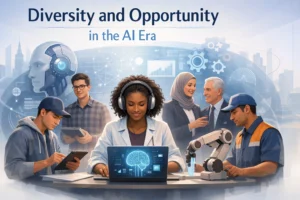
If managed properly, this subtle revival in entry-level hiring could create a wider range of opportunities. As a matter of fact, AI tools may help in implementing skills-based hiring, thus bypassing the need for an elite degree or a conventional career path. A few CEOs notice that junior employees coming from non-traditional backgrounds and being proficient in AI-related tasks greatly contribute to the company and show excellent performance. Still, the provision of AI education and the necessary tools is not meritoriously equal. If there are no inclusive hiring and training strategies implemented, then this tendency will, most probably, be a reserve for those who happen to have early exposure to technology only. Innovative company leaders now recognize that diversity and accessibility are central to AI-driven workforce planning.
A Subtle but Significant Shift
This shift remains largely undercover—small in scale, quiet in impact, and rarely discussed openly.
Companies may reduce these roles, implement hybrid work models, or rename the positions.
. But collectively, they represent a meaningful shift in how companies view early-career talent.
One CEO put it this way, “Artificial Intelligence has not eliminated the demand for entry-level employees.
It changed what we need them to do.”
What This Means for Job Seekers
Students and recent graduates may expect an optimistic future, but with a certain degree of caution. The number of opportunities is increasing; however, only for those who decide to collaborate with AI instead of competing against it. Experts in AI tools, comfortable with data, and having good judgment are already a must-have. On the other hand, human skills like communication, adaptability, and moral consciousness gain even more importance. People who make themselves collaborators empowered by AI will discover that there are more opportunities than they had anticipated
Conclusion
AI will transform the labor market for years, eliminating some jobs, evolving others, and creating entirely new roles. By and large, though, in somewhat different and less noisy ways, it is supporting the revitalization of the entry-level labor market through the extension of what junior talent can accomplish. The next generation may launch their careers because of AI, partnering with systems that augment—not replace—human capabilities.